Germany Commits €65m to Drive Nigeria’s Economic Reforms in New Bilateral Deal
 Claudia Kane
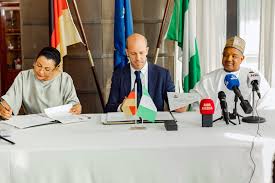
Germany has signed a €65 million Development Cooperation Agreement with Nigeria, covering economic governance, renewable energy transition, and vocational training. The deal was inked Thursday at the German Embassy in Abuja, where Nigeria’s Minister of State for Budget and Economic Planning, Dr. Doris Uzoka-Anite, led the Nigerian delegation.
Uzoka-Anite said the negotiations reflected both countries’ push to deepen collaboration across sectors critical to Nigeria’s development.
Additional €300m credit framework
Beyond the €65 million, Germany is offering a separate €300 million Export Credit Guarantee financing framework to back investment mobilization and long-term project financing. Germany’s Ministry for Economic Affairs and Energy will manage the credit line.
“We recognise that development cooperation must increasingly catalyse investment, innovation, and sustainable financing,” Uzoka-Anite stated. “This partnership is a concrete affirmation of our shared commitment to improving our people’s lives.”
The agreement spans agricultural transformation and food systems, climate and energy transition, sustainable economic development, skills acquisition and employment, health systems strengthening, and inclusive governance.
German ambassador highlights partnership depth
German Ambassador Annett Günther said the signing capped extensive bilateral engagements to review past achievements and chart a stronger path forward. Nine Nigerian ministries participated, alongside German development institutions BMZ, GIZ, and KfW.
Philip Knill, deputy director general of Germany’s Federal Ministry for Economic Cooperation and Development, reaffirmed Berlin’s long-term commitment to Nigeria. He said major German companies including Siemens, SAP, Bayer, and STIHL are actively exploring opportunities in Nigeria’s industrialization and energy sectors.
Existing programmes have already raised incomes for more than 16,000 SMEs. Around 600,000 smallholder farming households have gone through training that boosted their productivity by up to 90 percent — not a bad baseline to build from.
Sources: Leadership, The Nation, Arise News

Written by
Claudia Kane
General assignment reporter and News Editor at NaijaTrend. Covers breaking news, security, and national affairs across Nigeria.
You May Also Like
Ondo Investigates Suspected Poisoning After 24 Deaths
Ondo State authorities are investigating the deaths of 24 people in Odigbo Local Government Area after residents reporte…
 News
News
Police Hunt Suspects After Mob Kills Man In Akwa Ibom
Akwa Ibom police say they have begun a manhunt after a mob allegedly beat and set ablaze an unidentified man accused of…
 News
News
Nigerian Army Redeploys Generals, Names New Operation Hadin Kai Commander
The Nigerian Army has redeployed several senior officers and named Major General I. A. Ajose as Theatre Commander of Joi…
 News
News
NDLEA Arrests Fugitive Kingpin Linked To 49.7kg Heroin Shipment
NDLEA says Festus Ibewuike was arrested in Benin Republic and returned to Nigeria after more than two years on the run.