IMF cuts Nigeria’s 2026 growth forecast to 4.1% as Middle East war drives up costs
 Amina Garba
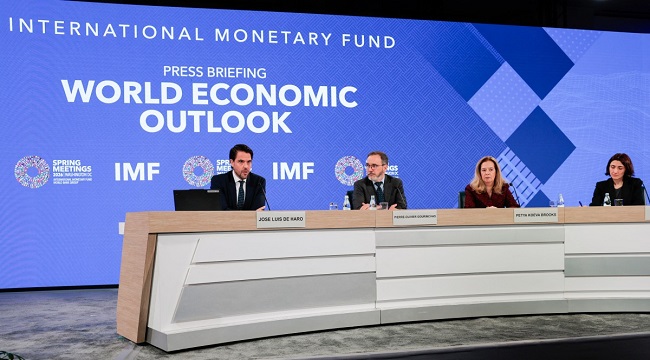
The International Monetary Fund has downgraded Nigeria’s 2026 economic growth forecast from 4.4% to 4.1%, pointing to the economic fallout from the Middle East conflict as the main reason for the cut.
The revision came in the IMF’s April 2026 World Economic Outlook, released on Tuesday during the IMF and World Bank Spring Meetings in Washington, D.C. It is the second time the Fund has adjusted Nigeria’s outlook downward in recent months, and the 0.3 percentage point reduction mirrors a broader global slowdown linked to rising energy prices and disrupted supply chains.
What the downgrade means
The IMF now expects Nigeria’s economy to grow at 4.1% in 2026, down from the 4.4% it projected in January. Growth is expected to recover slightly to 4.3% in 2027 as war-related cost pressures ease, the Fund said.
Global growth was also revised downward, from 3.3% to 3.1% for 2026, with the Fund blaming the Middle East conflict for most of the downgrade. The IMF presented three scenarios: a reference forecast (3.1%), a worse case, and a severe case that could push global growth down to 2% if the conflict escalates further and energy prices spike.
Why the cut
IMF Chief Economist Pierre-Olivier Gourinchas said the downgrade reflects pressures that hit energy-importing economies especially hard.
“On Sub-Saharan Africa, we are seeing some downgrade of growth, and we are seeing some uptick in inflation in a number of countries in the region,” Gourinchas told reporters. “The impact is very much along the lines of what we see more broadly — for a lot of the countries, especially the ones that are energy importers.”
Deniz Igan, who heads the IMF Research Department’s World Economic Studies Division, gave a more specific breakdown for Nigeria: “War-related higher fuel and fertilizer prices and higher shipping costs are going to weigh on non-oil activity in Nigeria. There’s some offset coming from higher oil prices, but the net balance is weaker growth in 2026.”
The Nigeria picture
For Nigeria, the Fund’s assessment is a mixed bag. Higher oil prices should boost government revenue and export earnings, which is a plus for an economy that still leans heavily on crude. But the benefits are being eaten into by rising costs of imported fuel, fertilizer, and shipping, which squeeze household budgets and non-oil businesses.
Nigeria’s inflation stood at 15.06% year-on-year as of February 2026, and the IMF warned that price pressures could worsen. The Fund said tight monetary policy from the Central Bank — which has kept its benchmark rate at 26.50% — will be “crucial to achieve the inflation target.”
Across Sub-Saharan Africa, the IMF projects median inflation will climb from 3.4% in 2025 to 5% in 2026, driven by higher energy and fertilizer prices, fuel shortages, and rising logistics costs.
The Fund also flagged a worrying drop in foreign aid, noting that bilateral assistance to the region fell between 16% and 20% in 2025, stripping away a key fiscal buffer just as commodity and shipping costs are rising.
Global context
The IMF’s revised outlook is not just about Nigeria. The entire global economy is feeling the impact of the Middle East conflict, particularly the disruption to shipping routes and energy markets caused by the Strait of Hormuz blockade. The Fund warned that if the conflict escalates, global growth could drop to 2% in 2026 with inflation exceeding 6% by 2027, with emerging markets bearing the heaviest burden.
“Central banks should remain vigilant and be prepared to act clearly and decisively in line with their mandates,” the IMF said, urging governments to keep fiscal interventions “targeted, timely, temporary” and backed by reprioritised spending to avoid worsening debt.
*Sources: IMF, Punch, TheCable, Channels TV, Daily Trust, BusinessDay*

Written by
Amina Garba
Financial reporter covering CBN policy, oil and gas, government budgets, and macroeconomic trends. Business Writer at NaijaTrend.
You May Also Like
 Business
NCC Begins Registration Of SIM-Enabled Devices, Targets Illegal Imports
The Nigerian Communications Commission has begun registering and authenticating SIM-enabled devices as it moves to tight…
 Business
NUPRC Threatens Revocation Of Idle Flare Gas Permits
The Nigerian Upstream Petroleum Regulatory Commission has warned that companies sitting on flare gas commercialisation p…
 Business
Reps Begin Probe Into N432bn Oil Revenue Debt
The House Public Accounts Committee is investigating debts owed to NMDPRA by NNPCL and oil marketers after audit finding…
 Business
Appeal Court Upholds Ex-NEXIM Bank MD Roberts Orya’s Fraud Conviction
The Court of Appeal in Abuja has upheld the fraud conviction of Roberts Orya, a former managing director of the Nigerian…